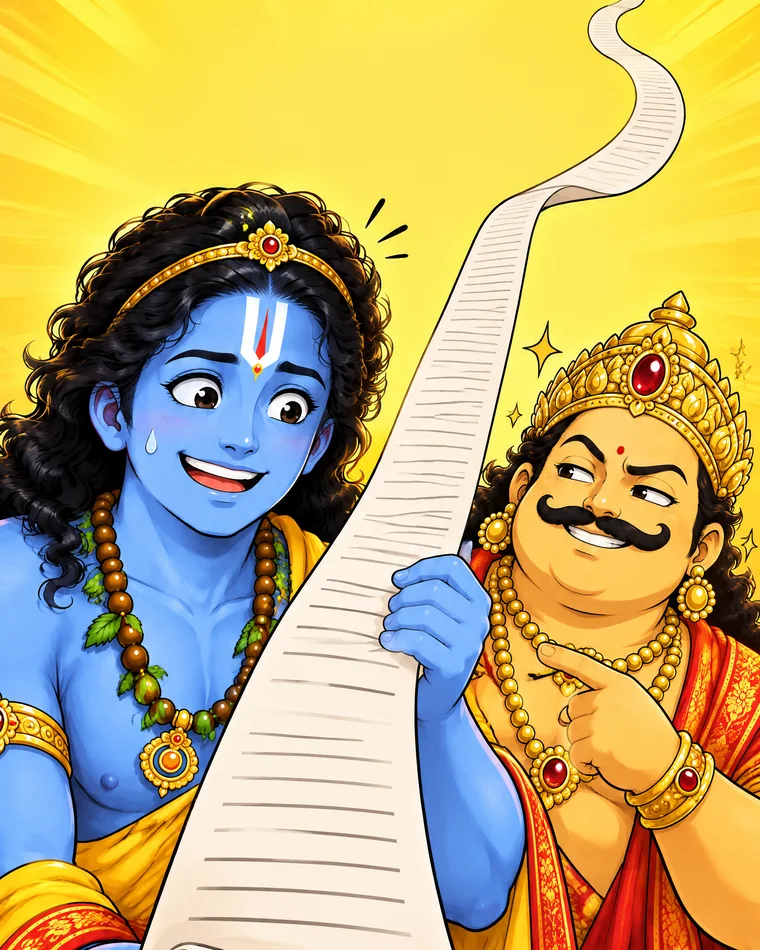
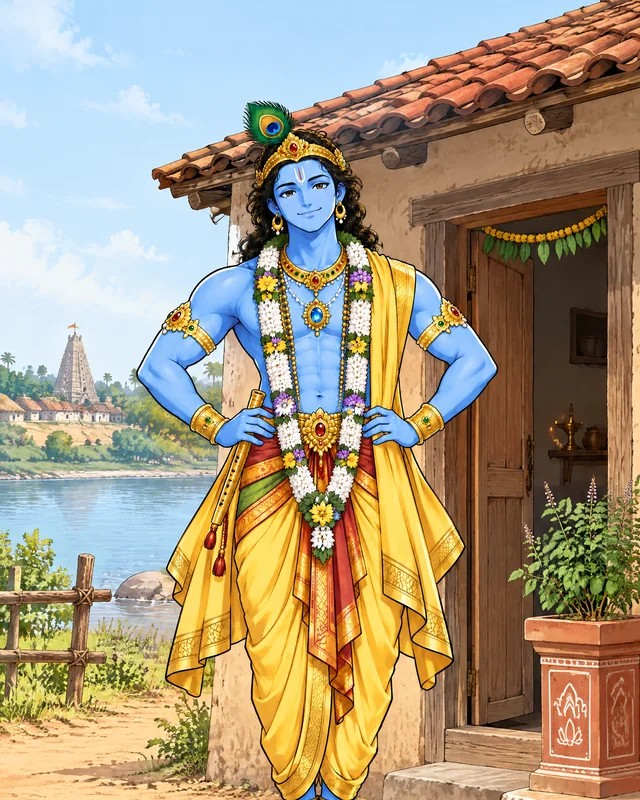
Lord Kubera drops in on Lord Venkateswara about this month's interest. The loan is very old, and the fine print is on page 108.
Background
The story behind it
At Tirumala, the temple tradition tells how Lord Vishnu came to earth as Lord Srinivasa, also called Lord Venkateswara, and wished to marry Goddess Padmavati. A royal wedding needed wealth, so he borrowed it from Lord Kubera, the treasurer of the gods.
The tradition says the loan was written down with witnesses, and that the Lord promised to repay it with interest until the end of Kali Yuga. Devotees say that is why offerings are placed in the hundi at Tirumala: each one helps the Lord pay back Lord Kubera.
The closing line plays on one old word. Koti can mean a crore, ten million, and it can also mean a kind or a class. So the thirty-three koti gods can be read as 33 crore gods or as thirty-three kinds of gods, which matches the thirty-three the Upanishad counts.
Lord Venkateswara reads the bill while Lord Kubera waits.
Sources
Where it comes from
Popular tradition
Tirumala temple tradition
Sri Venkatachala Mahatmyam (the wedding of Lord Srinivasa and Goddess Padmavati; popularly credited to its Bhavishyottara Purana section)
Lord Srinivasa borrows from Lord Kubera for his wedding to Goddess Padmavati and promises to repay the loan, with interest, by the end of Kali Yuga. Offerings in the hundi are understood as helping him repay it.
The phrase 'thirty-three koti devas' is widely understood as 33 crore gods. Koti also means a kind or class, which gives the other reading: thirty-three kinds of gods.
Fact or fun
Line by line
Check the hundi. I sent it yesterday.
Lord Venkateswara
Popular tradition
Hundi offerings at Tirumala are traditionally said to go toward repaying Lord Kubera.
After Kali Yuga.
Lord Kubera
Popular tradition
The tradition says the loan is to be cleared by the end of Kali Yuga.
Brahma was the witness!
Lord Venkateswara
Popular tradition
The popular telling names Lord Brahma and Lord Shiva as witnesses to the loan deed.
Thirty-three koti.
Lord Kubera
Popular tradition
The Upanishad counts thirty-three gods but does not use the word koti. Koti means both crore and kind, which is where the two readings come from.
Page one-oh-eight. Fine print.
Lord Kubera
Our imagination
There is no page 108. We picked the number because 108 is sacred.
That covered the late fee.
Lord Kubera
Our imagination
The late fee is our humour.
To me, everything is crore.
Lord Kubera
Our imagination
Our punchline, built on the two meanings of koti.
Our imagination
What we imagined
The monthly visit, the late fee and the fine print are ours.
The idea that every god has borrowed from Lord Kubera is our humour. Only Lord Venkateswara's loan belongs to the tradition.
Good to know
The honest footnotes
This story comes from the temple tradition of Tirumala rather than from the Vedas or the epics.
Both readings of 'thirty-three koti' are held by devotees. We do not pick one, and neither does Lord Kubera.
Found a mistake?
Tell us in the comments on YouTube. If you are right, we correct this page and say so.
 Gods' Chit-Chat