Sage Vyasa needs someone to write down the Mahabharata. Lord Ganesha takes the job, and each of them adds one condition.
Background
The story behind it
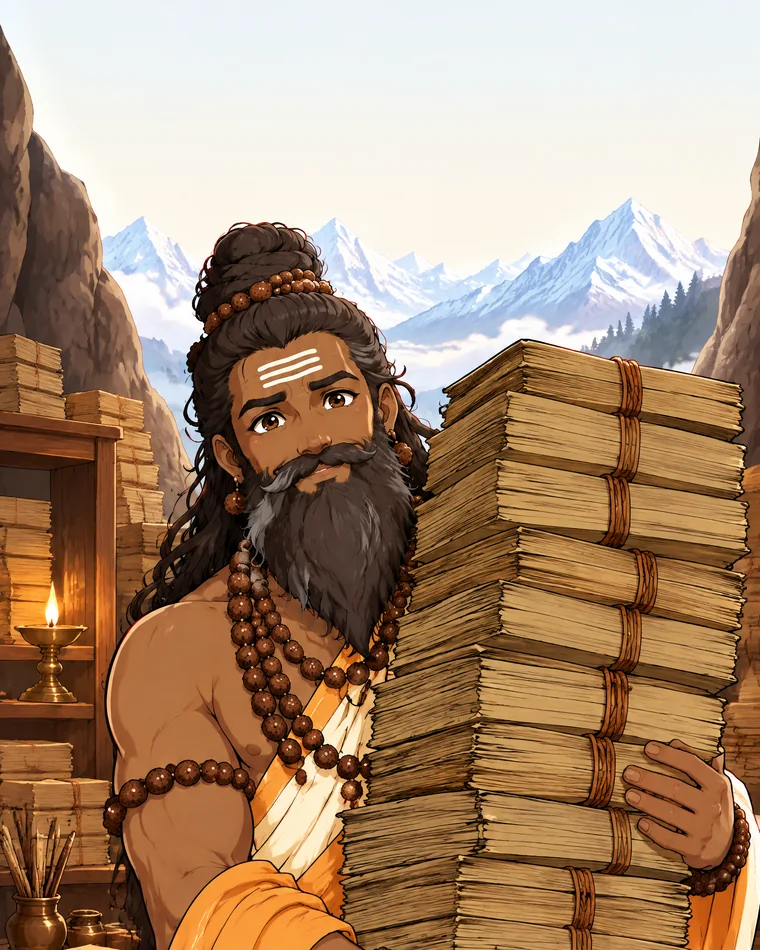
Sage Vyasa had composed the whole Mahabharata in his mind. It was so vast that he could not think of anyone on earth able to write it down. In the telling found in the opening book of the epic, Lord Brahma comes to him and advises him to call on Lord Ganesha.
Lord Ganesha agrees, on one condition: his pen must not stop for even a moment. Sage Vyasa accepts, and sets a condition of his own in return: Lord Ganesha must not write down a single verse without first understanding it.
That second condition is the clever part. The sage knit knotty verses into the work, and while even Lord Ganesha paused over their meaning, he composed many more. Tradition reads this as the sage buying himself time. The narrator Sauti says there are 8,800 such verses, and that only he, Shuka and perhaps Sanjaya know their meaning.
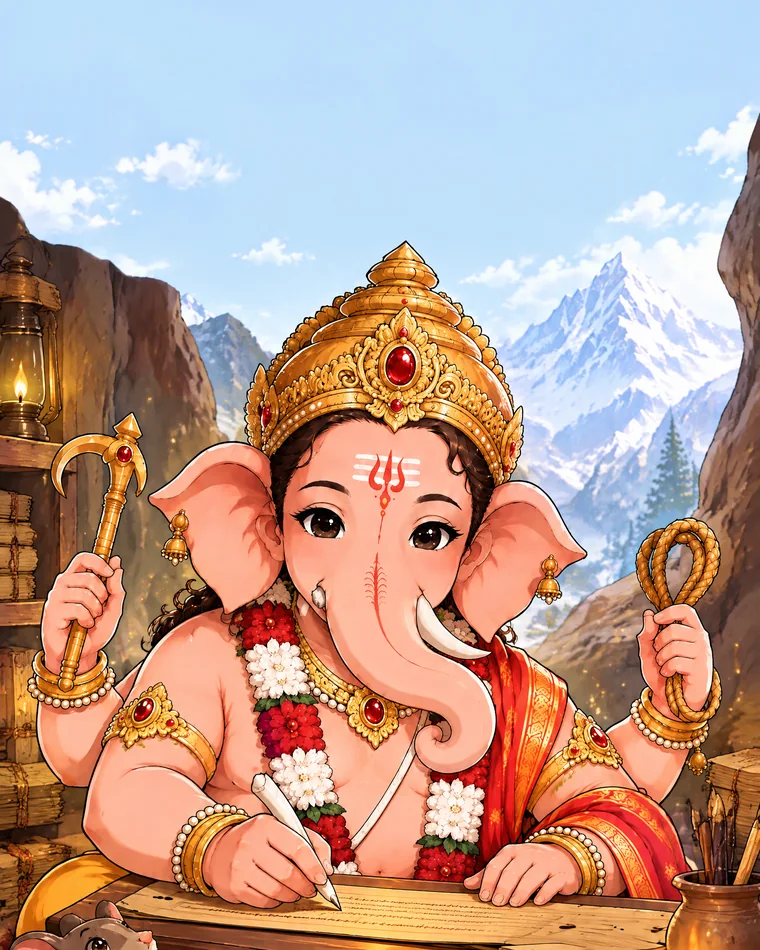
A much-loved tradition adds the ending most of us grew up with. When his pen broke in the middle of the work, Lord Ganesha broke off his own tusk and went on writing, so that the dictation never had to stop. It is one of the stories told to explain his name Ekadanta, the one with a single tusk.
Sage Vyasa with the palm-leaf bundles of the epic.Lord Ganesha writes on with his own tusk.
Sources
Where it comes from
In the text
Mahabharata, Adi Parva
Section 1 (Anukramanika Parva), K. M. Ganguli translation
Lord Brahma advises Sage Vyasa to ask Lord Ganesha. Lord Ganesha's condition is that his pen must not stop. Sage Vyasa's condition is that nothing is written without being understood. The sage knits difficult verses into the work and composes more while Lord Ganesha pauses over them; the narrator speaks of 8,800 such verses.
The contents of the epic are listed book by book: eighteen parvas in all.
Popular tradition
Popular tradition
The broken tusk
The pen breaking and Lord Ganesha writing with his own tusk is a beloved traditional telling. It is not part of the Mahabharata passage above, which mentions no broken pen.
Fact or fun
Line by line
One hundred thousand verses.
Sage Vyasa
In the text
The epic describes its version for the human world as one hundred thousand verses long.
You understand every verse before you write it.
Sage Vyasa
In the text
This is Sage Vyasa's condition in the Adi Parva.
You never stop dictating.
Lord Ganesha
In the text
This is Lord Ganesha's condition: his pen must not stop for a moment.
You're buying time.
Lord Ganesha
In the text
The text says the sage knit knotty verses into the work and composed many more while Lord Ganesha paused over them. That he did it to gain time is the traditional reading.
My pen just broke.
Lord Ganesha
Popular tradition
The broken pen and the tusk come from popular tradition, not from the Adi Parva passage.
Eighteen.
Lord Ganesha
In the text
The Mahabharata has eighteen books, called parvas.
Page one. Fine print.
Lord Ganesha
Our imagination
There was no written contract. In the text both conditions are simply spoken and agreed.
One.
Lord Ganesha
Our imagination
The idea that they are still on the first book is our humour.
Our imagination
What we imagined
The whole conversation is set up as a modern job offer, with a contract and fine print.
Lord Brahma, who suggests Lord Ganesha in the text, does not appear in our episode.
The closing line, that after all this they are still on book one, is ours.
Good to know
The honest footnotes
The passage with Lord Ganesha as the scribe is found in many manuscripts of the Mahabharata but not in all of them. The Critical Edition prepared at the Bhandarkar Oriental Research Institute in Pune does not include it in its main text, and many scholars regard it as a later addition. We follow the traditional telling because it is the one people know and love.
Other traditions explain Lord Ganesha's single tusk differently. In the Brahmanda Purana (Upodghata-pada, chapter 42), Lord Ganesha sees that the axe of Lord Parashurama was a gift from his own father, Lord Shiva, and receives it on his left tusk so that it does not go in vain.
Found a mistake?
Tell us in the comments on YouTube. If you are right, we correct this page and say so.
 Gods' Chit-Chat